There is a quiet expectation we place on tea that I’m not sure we talk about enough.
We expect it to calm us.
To slow us down.
To make everything feel a little more intentional, a little more put together, a little more peaceful than whatever came before it.
But I’ve started to wonder if that expectation is always fair.
Most tea moments in real life are not peaceful in the way we imagine them to be. They happen between things. Between messages. Between deadlines. Between thoughts that refuse to slow down just because a cup has been poured.
And yet, when we talk about tea, we often describe it as though it exists outside of real life.
As if every cup is meant to be a retreat.
A reset.
A small escape from everything else.
I don’t think that’s always true.
Sometimes tea is just there while life continues around it.
I’ve had tea while worrying about things I couldn’t solve. I’ve had tea while rushing through tasks I didn’t fully finish. I’ve had tea while half paying attention to conversations I probably should have listened to more carefully.
And strangely, those cups were still meaningful in their own way.
Not because they were peaceful, but because they were present.
There is something slightly unrealistic about the idea that tea must always bring calm. It suggests that the drink has a responsibility to fix the moment we are in. But tea is not a solution. It is not a mood switch.
It is simply something warm we hold while life is happening.
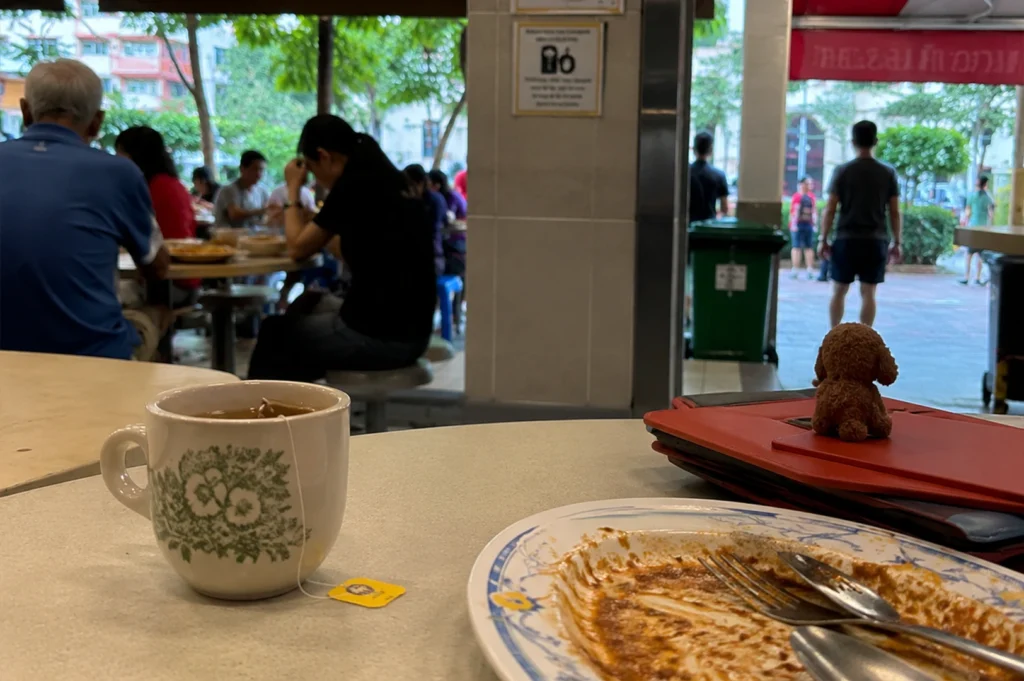
In Singapore especially, where days move quickly and spaces are shared tightly, tea often exists inside movement rather than outside it. A cup at a hawker table. A quick brew at home before heading out. A pause that lasts only as long as it needs to.
Maybe we don’t need tea to transform every moment.
Maybe we just need it to accompany them.
Not to make life perfect.
But to make it a little more human.
And perhaps that is enough.
— Maria Tan
On tea, culture, and everyday rituals.

Wellness Tea Is a Scam, but Tea Can Still Be Good for You
There is a strange contradiction in the way we talk about tea today. For centuries, tea was appreciated for its taste, its rituals, and the moments it created. Today, it is often sold as something else entirely. A solution. A promise. A shortcut. The language surrounding wellness tea has become increasingly familiar. Detox tea. Cleansing…
-
Camellia Tea: A Blossom, A Leaf, A Legacy Rooted in Camellia Sinensis
My grandmother kept her camellia tea in a battered tin that had once held biscuits. She never called it anything fancy. It was just cha, brewed strong in the mornings using fresh tea leaves from the tea plant, poured into small cups that had lost their matching saucers years ago. I didn’t know then that…
-
Why “Caffeine-Free Tea” Marketing Should Be Regulated (Seriously)
Hear me out: we have become far too comfortable with the phrase “caffeine-free tea.” It appears on beautiful packaging, wellness websites, and café menus with the confidence of a health guarantee. The words suggest calm evenings, better sleep, and a gentler relationship with what we drink. But there is a problem. The phrase sounds clearer…
-
The Forgotten Luxury of Sitting Still at Japanese Tea House
You stoop to enter the traditional japanese tea house. That is the first thing the tea house asks of you, before the tea, before the talk, before anything at all. The doorway is low, deliberately so, and even the tall must bow to pass through it. In that small act of folding the body, something…
-
Stop Calling It “Premium”: Why Most Luxury Tea Branding Is Empty
There is a word I have become increasingly cautious of in the tea world. Premium. It appears everywhere. Premium leaves. Premium harvests. Premium collections. Premium experiences. The word sounds reassuring. It suggests care, quality, and something worth paying attention to. But after seeing it attached to almost everything, I sometimes wonder whether it has started…
-
Pryce Tea: A Modern Pour with Old Tea-Room Ambitions
I visited on a weekday afternoon, around three, when the city had quieted into that particular lull between lunch and the evening rush. I’d been curious about Pryce Tea for a while, mostly because the brand keeps surfacing among people who talk about teas the way some people talk about wine. With a reputation built…
-
The Seasons in a Tin: How Weather Shapes What I Reach For
I have a small habit that I never really noticed until recently. The weather changes, and somehow, so does the tea I want. On a hot afternoon, I find myself reaching for something light and floral. When rain settles over the windows, I want something darker, warmer, perhaps a little more comforting. On those rare…
-
Ginger Lily Afternoon Tea on Orchard Road: A Floral Chapter in Singapore’s Culinary Story
I noticed the ginger lily flowers before I noticed anything else. Not real ones, exactly. A wall of them, suspended in resin, catching the light as I stepped off the lift on Level 5 at Hilton Singapore Orchard, home to Ginger Lily, a floral-themed afternoon tea lounge on Orchard Road. I stood there a second…
-
Minimalism, But Make It Warm: A Simpler Way to Drink Better Tea
There is a certain irony about tea. The more we learn about it, the easier it becomes to complicate it. A simple cup of leaves and water slowly becomes surrounded by equipment, measurements, techniques, and expectations. We begin collecting teapots, comparing brewing methods, and searching for the perfect setup. None of these things are wrong….
-
A Humble Cup in an Age of Overdesigned Drinks: iTea Review
The bubble tea I queued for last month came with a caramelized brûlée top I had to crack with the back of my spoon. It was fine. Pretty, even. But somewhere between the torched sugar and the cheese foam and the third topping I didn’t ask for, I lost the drink itself. So I went…