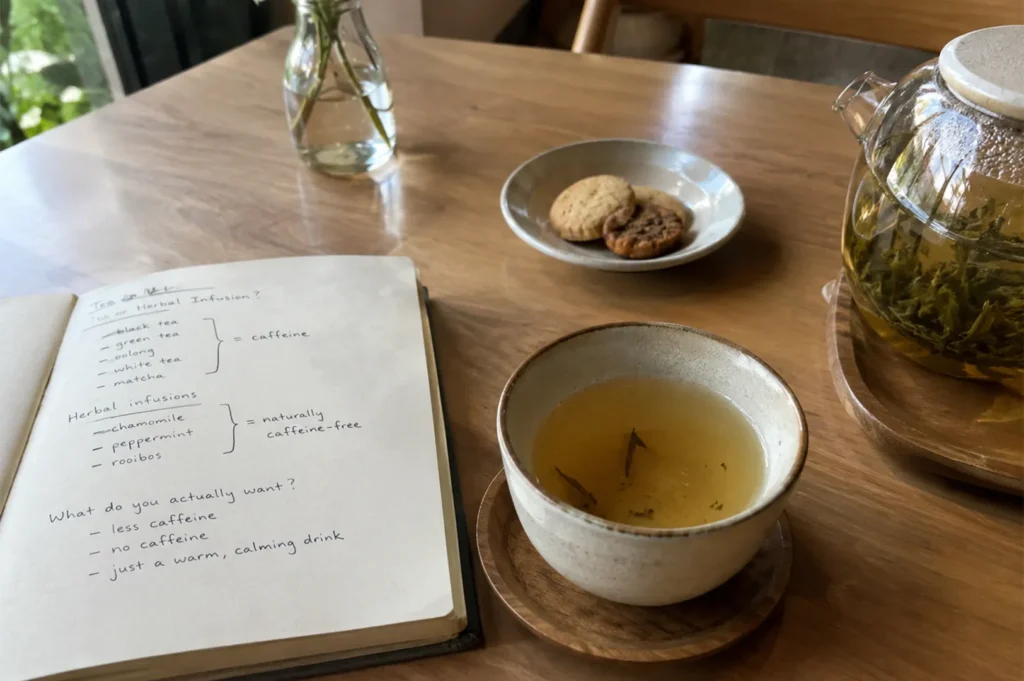
I have noticed that tea conversations can become surprisingly confusing.
Not because tea itself is complicated, but because we sometimes use the same words to mean completely different things.
One phrase that always catches my attention is “caffeine-free tea.”
It sounds simple enough.
But is that really what we mean?
Because technically, many traditional teas are not completely caffeine-free. Black tea, green tea, oolong, white tea, and matcha all naturally contain caffeine because they come from the Camellia sinensis plant.
What many people are actually looking for is something slightly different.
A tea with little or no caffeine.
Or perhaps a naturally caffeine-free herbal infusion.
The distinction seems small, but it matters.
I think part of the confusion comes from how we casually use the word “tea” for almost everything we steep in hot water. A cup of chamomile, peppermint, or rooibos is often called tea, even though they are technically herbal infusions rather than traditional tea.
And honestly, I understand why.
Language follows everyday life. Most people are not thinking about botanical categories when they are choosing a comforting drink before bed.
They simply want something warm.
Something calming.
Something that will not keep them awake.
But perhaps understanding the difference can make our choices easier.
A person looking for a naturally caffeine-free option might enjoy herbal infusions. Someone who wants the flavour and tradition of tea but less caffeine might explore lighter teas or adjust how they brew them.
Neither choice is more correct.
This is what I find interesting about tea. The more we learn about it, the more we realise how many assumptions we carry.
We think we know what tea means.
Then we discover there is another layer.
But I also think we should be careful not to make tea feel like a vocabulary lesson. At the end of the day, people are not searching for the perfect term. They are searching for a drink that fits their lives.
Sometimes that means a delicate green tea in the morning.
Sometimes it means a cup of chamomile before bed.
Sometimes it means simply knowing what is actually inside your cup.
Maybe the goal is not to correct everyone who says “caffeine-free tea.”
Maybe the goal is to make the conversation clearer.
Because tea is already interesting enough without making it harder to understand.
— Maria Tan
On tea, culture, and everyday rituals.

A Tea Lover’s Guide to the Best Japanese Restaurant Singapore Dining Experiences
Searching for the best Japanese restaurant Singapore offers usually leads people toward sushi counters, omakase menus, or beautifully plated sashimi. Those elements certainly define much of the appeal of Japanese cuisine, but anyone who has spent time dining in Japan knows that the experience rarely ends with the food alone. Tea quietly accompanies the meal….

Why Tea Conversations Always Last Longer Than Expected
There is a small pattern I have started to notice about tea. Whenever tea is involved, conversations tend to last longer than planned. Someone says they will only stay for a short while. A kettle is placed on the stove. Tea is poured into a few cups, and suddenly the conversation begins to stretch in…
-
White Tea: The Most Delicate Expression of Chinese Tea
Introduction Among the many tea types that have emerged from centuries of tea cultivation, white tea often stands apart for its quiet character. It is light in colour, gentle in aroma, and remarkably simple in its making. Yet behind this softness lies a long tradition of craftsmanship that has shaped some of the most refined…
-
The Quiet Discipline of Brewing Tea
There is a quiet discipline that lives inside the act of brewing tea. It is not something that announces itself loudly. There are no strict rules written on the wall, no visible signs that something significant is taking place. From the outside, the process appears simple enough. Water is heated. Leaves are placed into a…
-
Understanding the Six Types of Chinese Tea and What Makes Each Unique
Introduction Across centuries of Chinese culture, tea has held a place of quiet importance. It appears in homes, markets, and tea houses across China, where the simple act of sharing a cup reflects patience, hospitality, and tradition. For many people, Chinese tea is not only a beverage. It is a moment of reflection and a…
-
Stepping Into a Tea Shop Singapore: A World of Leaves, Craft, and Calm
Introduction A good tea shop Singapore offers is not simply a place to buy tea. It is a place where flavour, craft, and tradition meet. In a city known for speed and convenience, a proper tea house offers something different. It invites people to slow down, pay attention, and actually taste what is in their…
-
When Tea Becomes Too Beautiful to Drink
I recently saw a photograph of a tea session online that looked almost too perfect. The teapot sat neatly on a polished tray. The cups were aligned in a way that suggested someone had carefully adjusted them, perhaps more than once. A small branch of flowers leaned gently toward the tea set as if it…

How Tea in Singapore Traveled From Colonial Tables to Modern Teahouses
Tea in Singapore moves quietly through the day, carrying within its steam the gentle convergence of traditions that have found their way to this island over generations. In the soft morning light of hawker centers, the rhythmic pour of teh tarik creates small moments of pause, while afternoon finds its way into tranquil tea rooms…

Are We Drinking Tea or Just Collecting It?
There was a time when buying tea meant something simple. You chose a tea you liked, brought it home, and brewed it. The leaves were meant for hot water, not long-term storage. Yet something has quietly changed. Today it is not unusual to meet tea drinkers with shelves filled with sealed cakes, tins, and packets…

The Soul of Tea: Unveiling the Beauty of Traditional Tea Ceremonies
Tea is more than just a drink, isn’t it? It is a quiet moment in the middle of a busy day, a small ritual that grounds us. We are not just drinking tea; we are experiencing something far more profound, a glimpse into the centuries-old traditions of cultures that revere this simple beverage. Whether in…