There is a curious assumption in tea culture that I have never quite understood.
If you are new to tea, you begin with something floral.
Jasmine. Rose. Osmanthus. Lightly scented blends.
Then, supposedly, you move on.
You discover roasted oolongs. Aged teas. More complex leaves. Stronger flavours. Eventually, you become a “serious” tea drinker.
I have always found this progression rather strange.
Why should subtlety be considered an introduction rather than an achievement?
A good floral tea can be remarkably difficult to appreciate. Its character is often quiet. It does not overwhelm the palate or announce itself immediately. You have to notice what happens between the aroma and the finish, between the fragrance and the leaf beneath it.
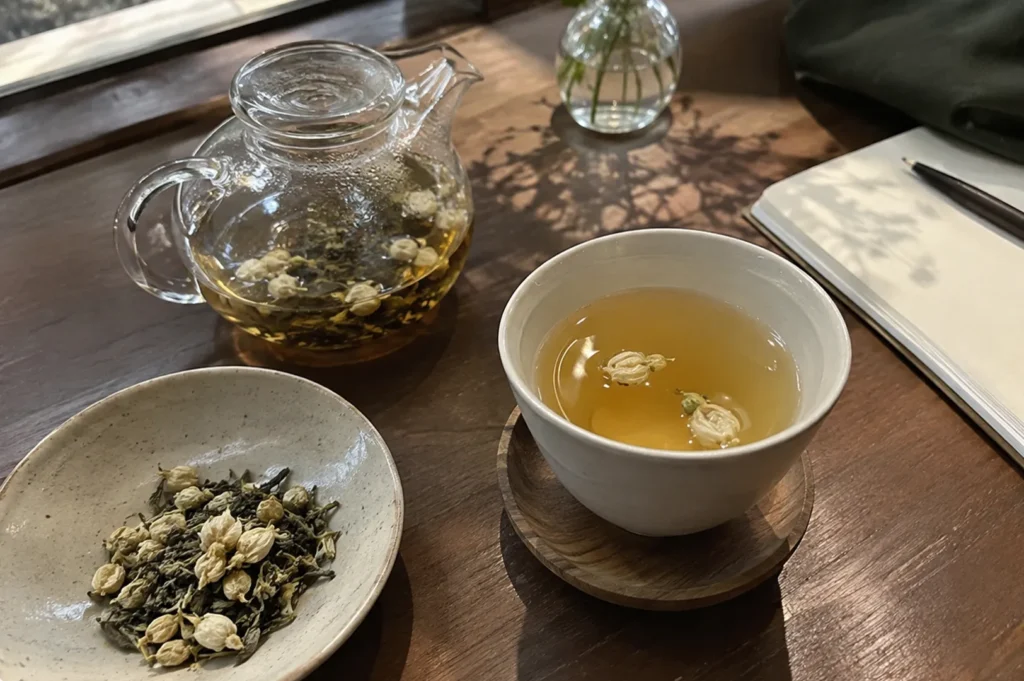
Jasmine tea is a good example.
The jasmine may be the first thing you notice, but it should not be the only thing you taste. Beneath the fragrance is the tea itself, carrying its own texture and character. When the two are balanced properly, neither needs to dominate.
That balance requires restraint.
And restraint is not always easy.
I have tasted teas that were far more expensive and far more celebrated, yet I found myself returning to a simple floral tea instead. Not because it was more impressive, but because it gave me something I wanted from that particular moment.
Perhaps this is what happens as our relationship with tea changes.
In the beginning, we often look for intensity. We want flavours that are obvious and memorable. We want the tea to tell us immediately why it deserves our attention.
Eventually, some of us begin looking for something quieter.
A fragrance that does not overwhelm.
A finish that stays a little longer.
A tea that reveals itself without demanding to be noticed.
This is not to say floral teas are inherently better. They are not.
But perhaps we should stop treating them as stepping stones toward more “serious” tea.
Taste does not always become more sophisticated by becoming stronger.
Sometimes it becomes more sensitive.
And perhaps that is why I still return to floral teas.
Not because I have yet to graduate from them.
Because I no longer feel the need to.
With quiet regard,
N. P. Lim

The Tea We Drink for No Reason
Tea is often praised for its ritual, its mindfulness, its ability to transform ordinary moments into quiet ceremonies. And I appreciate all of that. I really do. But there is another kind of tea, one that rarely gets mentioned in articles or recommended in guides. The tea we drink for no reason at all. I…
-
A Tea Lover’s Map to Elegant Finds in the City Teaware Shop
There is a particular quiet that settles when you pour hot water over tea leaves in a pot you chose with care. The weight of the clay in your hand. The porcelain capacity that holds just the right amount of warmth. A small ritual, repeated, until it becomes yours. Singapore knows tea in many languages….
-
Why We Pretend Every Tea Moment Should Be Peaceful
There is a quiet expectation we place on tea that I’m not sure we talk about enough. We expect it to calm us. To slow us down. To make everything feel a little more intentional, a little more put together, a little more peaceful than whatever came before it. But I’ve started to wonder if…
-
The Discipline of Grace in Every Bowl: Tea Ceremony in Japan
Water begins to move in a small iron kettle. The sound is faint, almost like wind through pines, and in a quiet room lined with tatami mats, it is enough to fill the silence. A host kneels in the tea room. A guest waits. Nothing is said, yet something has already begun. This is where…
-
The Tea I Keep Drinking When I Don’t Feel Like Myself
There are days when tea feels unnecessary. Not because I stop liking it, but because I don’t feel like the version of myself who usually drinks it slowly, thoughtfully, and with attention. On those days, I still make tea anyway. Not out of ritual, but out of habit. It is never the elaborate kind of…
-
Tea Ceremony Kyoto: A Slow Dance of Bowls and Breath
The room is quiet enough to hear water. Somewhere beyond the paper screens of this traditional tea ceremony venue, a garden drips after morning rain. Inside a tea house on a tatami mat worn soft by years of kneeling, a tea master lifts a bamboo whisk and begins tea making. There is no rush in…
-
Why We Keep Romanticising Tea Moments That Never Happened
I sometimes wonder if we are drinking tea or remembering something that never really happened. A quiet morning that feels softer in memory than it ever was in real life. A perfect cup by the window that somehow always looks better in hindsight. A tea moment that feels cinematic, even though it probably lasted only…
-
Masala Chai Tea Origins: The Cultural Evolution of India’s Spiced Tea Tradition
There is a sound that belongs to mornings across India: the hiss of milk rising in a battered pot, the clink of a spoon against metal, the low murmur of a tea seller calling out to passing crowds. Before the first sip, there is the scent. Cardamom pods, fresh ginger, and cinnamon stick curling into…
-
We Are Turning Tea Into Something It Was Never Meant to Be
There is something quietly strange happening in tea culture. The more popular the tea becomes, the more it starts to resemble everything it once stood apart from. Speed. Branding. Productivity. Performance. Tea, which once belonged to unhurried moments, is increasingly being asked to do more. To energize. To optimize focus. To replace coffee. To support…
-
Sencha Green Tea vs. Matcha Powder: Understanding the Differences in Japanese Green Tea
Two tins of tea powder sit side by side on a shelf. Both hold a fine green powder. Both promise the taste of authentic Japanese tea. To the eye, they look almost identical, and that is precisely where the confusion begins. One is matcha powder, often used in matcha lattes and desserts. The other is…