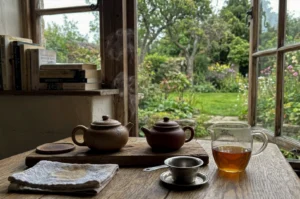
There is a word I have become increasingly cautious of in the tea world.
Premium.
It appears everywhere.
Premium leaves. Premium harvests. Premium collections. Premium experiences.
The word sounds reassuring. It suggests care, quality, and something worth paying attention to. But after seeing it attached to almost everything, I sometimes wonder whether it has started to mean very little at all.
A tea can be expensive without being memorable.
A tea can come in beautiful packaging without offering a meaningful experience.
A tea can carry a luxurious story and still leave the drinker wondering what made it truly special.
This is not to dismiss the craftsmanship behind fine tea. There are farmers, producers, and artisans who spend years refining their work. Certain teas genuinely deserve recognition for their rarity, complexity, and history.
But somewhere along the way, the language around tea has become louder than the tea itself.
We are often introduced to the story before we meet the leaves.
The mountain.
The limited batch.
The exclusive release.
The carefully designed box.
By the time the tea reaches the cup, expectations are already impossibly high.
And perhaps this is where the problem begins.
Tea has always been a quiet experience. It reveals itself slowly. It asks for attention, not admiration. A good tea does not need to announce its value before the first sip.
I have tasted teas that carried impressive descriptions but left little impression. I have also tasted humble teas that stayed with me long after the cup was empty.
The difference was not always quality.
Sometimes it was connection.
A tea becomes meaningful because of how it fits into our lives. The morning we drank it. The conversation that surrounded it. The quiet moment when we needed something familiar.
No label can create that.
Perhaps the tea industry has become too focused on making people believe they need something better, rarer, or more exclusive. But tea appreciation was never meant to be a search for status.
It was meant to be a relationship.
This does not mean we should ignore craftsmanship or stop exploring exceptional teas. Curiosity is part of what makes tea beautiful.
But perhaps we should be more careful with the word premium.
Because the best tea is not always the one with the highest price or the grandest description.
Sometimes it is simply the one that makes us want another cup.
With quiet regard,
N. P. Lim

What Kopi and Tea Say About Singapore
One of the things I love most about Singapore is that we never really chose between kopi and tea. We kept both. Walk into almost any hawker centre or coffee shop and you’ll see it immediately. One person orders kopi-o. Another asks for teh-c. Someone else is drinking Chinese tea from a flask they brought…
-
The Tea We Keep Saving for Later
Many tea drinkers have a tea they are saving. A special oolong purchased during a memorable trip. A rare tea gifted by a friend. A tea that feels too valuable, too limited, or too meaningful to drink casually. So it waits. Days become weeks. Weeks become months. The tea remains carefully stored while more ordinary…
-
Earl Grey Tea Benefits: What Is Earl Grey Tea and Why Has It Endured for Centuries?
Introduction Few teas are as instantly recognisable as Earl Grey tea. Even among people who do not regularly drink tea, the distinctive citrus aroma of Earl Grey often feels familiar. It appears in tea shops, cafés, afternoon tea menus, and kitchen cupboards around the world, yet many people still ask the same question: what is…
-
Can You Call Yourself a Tea Lover If You Don’t Like Matcha?
I have a confession. I don’t think every tea lover needs to love every tea. That sounds obvious when written down, but spend enough time around tea enthusiasts and you may start to think otherwise. Someone discovers that you enjoy tea. The questions begin. Do you drink green tea? What about pu-erh? Have you tried…
-
Is Tea Acidic? Understanding Tea Acidity and What It Means for Tea Drinkers
One of the most common questions among both new and experienced tea drinkers is surprisingly simple: is tea acidic? The answer is yes, but the reality is far more nuanced than a simple yes or no. Most teas fall on the mildly acidic side of the pH scale, yet they are generally far less acidic…
-
The Best Tea Sessions Are Usually Unplanned
Some of the most memorable tea sessions begin without intention. No special occasion. No carefully selected tea ware. No plan to spend an afternoon appreciating tea. Someone simply puts water on to boil. A tea is chosen almost absentmindedly. Cups are found. The tea is poured. And somehow, those sessions often become the ones we…
-
A Guide to the Wedding Tea Ceremony in Singapore: Tradition, Family, and Meaning
I still remember the morning of my older sister’s wedding day. We were packed into my parents’ flat, and the sticky humidity in the air was intense, even with the air conditioning running on full blast. Amidst the loud laughter and the fun of the morning gatecrash, everything suddenly slowed down. I watched her kneel…
-
Why Tea Gifts Always Feel More Personal
There are easier gifts to buy than tea. Gift cards, flowers, candles. They require very little thought. Most people will appreciate them, and if they don’t, no real harm is done. Tea feels different. Giving someone tea involves a small act of interpretation. You are making a quiet guess about what they might enjoy. Something…
-
Wabi Sabi Meaning: Discovering Beauty in Imperfection
Singapore is famous for its spotless streets, impressive glass towers, and a culture that constantly celebrates the new-be it design trends, the latest matcha drinks, or the next “perfect place” for brunch. For a long time, I bought into this idea of curated perfection. My home had to be pristine, my days measured for maximum…
-
The Strange Pressure to Understand Every Tea Immediately
Tea drinkers do something interesting. When trying a new tea, many immediately begin searching for the “correct” tasting notes. Floral. Roasted. Fruity. Mineral. Someone takes a sip and suddenly feels pressure to identify every subtle characteristic as though there is a right answer hidden somewhere inside the cup. And if the tea feels confusing at…