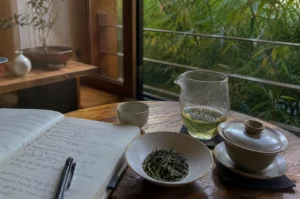
You stoop to enter the traditional japanese tea house.
That is the first thing the tea house asks of you, before the tea, before the talk, before anything at all. The doorway is low, deliberately so, and even the tall must bow to pass through it. In that small act of folding the body, something loosens. The rush you carried in from the street stays outside, on the other side of the wood.
Nothing here hurries you. That is the point.
In a world that measures worth in speed and volume, the japanese tea house holds onto an older idea rooted in zen philosophy and the japanese way. It suggests that sitting still, fully present, with a cup of hot matcha warming your hands and delicate wagashi served alongside, might be one of the last luxuries left. Not a luxury of excess. A luxury of attention and calm.
What a Japanese Tea House Really Represents in Japanese Culture

A japanese tea house, or chashitsu, is easy to mistake for a small room where people drink japanese tea. It is that, but only in the way a temple is a building with a roof.
The chashitsu was never designed for convenience. It was built as a space set apart, a place where the ordinary rules of the day are suspended. Here, tea is not a beverage to be consumed. It is an occasion to be entered, the essence of the tea ceremony.
Everything in the room is chosen to draw the mind into the present. The single hanging scroll with calligraphy. The one tea flower, placed just so in a simple container. The kettle over the hearth, the bowl, the movement of hands and utensils. The chashitsu asks its guests to notice, and in noticing, to slow.
This is a space built around presence and hospitality that does not perform but attends. Around the belief that how you do a small thing matters as much as the thing itself. The art of the ceremony is reflected in the refined simplicity of the architecture and the harmony of the space.
The Cultural Roots of Stillness: The Tea Ceremony and Wabi Cha

To understand the tea house, you have to understand what happens inside it. That is chanoyu, the japanese tea ceremony, also called the japanese way of tea or wabi cha.
Chanoyu is often translated as "the way of tea," and the phrase is fitting. It is less an event than a practice, refined over centuries and shaped most famously by the tea master Sen no Rikyu in the sixteenth century. He stripped the ceremony of excess and returned it to something plain and profound, embodying the philosophy of wabi-sabi.
At its heart sit four principles: harmony, respect, purity, and tranquility. In Japanese, wa, kei, sei, jaku.
Harmony asks that host, guest, and setting move as one, without friction. Respect flows both ways, host to guest and guest to host, carried in small gestures. Purity is the cleaning of the space and the clearing of the mind, a readiness to be fully there. Tranquility is what remains when the other three are honored, a stillness that settles over the room.
These are not decorations on the ritual. They are the ritual. A matcha tea ceremony can take hours, and much of that time is spent in careful, quiet motion. The whisking of the bright green tea. The turning of the bowl. The pause before the first sip.
None of it is efficient. All of it is intentional.
Wabi-Sabi and the Beauty of Restraint in Tea Rooms

There is a word that runs beneath all of this, and it is worth sitting with. Wabi-sabi.
It resists clean translation, but it points to a way of seeing beauty in what is modest, imperfect, and impermanent. The crack in an old bowl. The faded grain of weathered wood. The single blossom already beginning to fall.
Where much of the modern world equates beauty with the new, the flawless, the polished to a shine, wabi-sabi looks the other way. It finds quiet dignity in age and wear. It trusts that something humble can hold more feeling than something grand.
You see this everywhere in the tea house and tea rooms. The rough clay of a tea bowl, uneven under the fingers. The plain plaster walls. The muted, natural tones that let the eye rest rather than race. Nothing shouts for attention, and so everything can be noticed.
This restraint is not poverty. It is a choice. The tea house strips away the unnecessary until only what matters remains: the tea, the guest, the moment, the light. In that emptiness, there is room to breathe.
Architecture That Slows the Body Down and Engages the Senses

The genius of the traditional japanese tea house is that it does not merely suggest stillness. It builds it into the body and the senses.
Consider the approach. Guests do not walk straight in. They pass along the roji, the garden path, often laid with stepping stones set at uneven intervals. You cannot stride across them. You must watch your feet, slow your pace, and by the time you reach the door, the pace of the busy city has already left you.
Then comes that low entrance, the nijiriguchi. Kneeling to pass through it was once a great leveller. Samurai left their swords outside because the sword would not fit through the door. Inside, all guests were equal, humbled by the same small opening.
The materials do their own quiet work. Tatami mats underfoot, firm yet giving, dictate how you sit and how you move. Sliding paper doors, the shoji, filter harsh light into something gentle. Wood, bamboo, clay, and paper surround you, all of them natural, all of them warm to the eye.
The proportions are intimate, sometimes only a few mats in size. In such a room, you cannot sprawl or hide. You are seated close to the others, close to the tea. This is japanese architecture used not to impress, but to hold.
Every detail conspires toward the same end. The body slows because the space gives it no reason to hurry.
Why This Kind of Luxury Feels Forgotten in Modern Japan

Ask most people to picture luxury, and they will reach for images of abundance. Speed. Size. Something rare and expensive, photographed well, held up for others to see.
The tea house offers almost none of that.
There is nothing to show off in a chashitsu. No spectacle to capture. The whole experience unfolds in a small, plain room, over a bitter green tea, in near silence. By the measures of modern indulgence, it looks like nothing at all.
And yet.
What the tea house offers is precisely what has grown scarce. Time that is not being spent on something else. Attention that is not split across a dozen screens. A space where you are asked to do one thing, drink tea, and to do it fully.
We live surrounded by convenience, and convenience has its gifts. But it has quietly taught us that waiting is waste, that stillness is idleness, that a moment not documented is a moment lost. Against that current, the tea house stands still on purpose.
This is the luxury we have forgotten. Not the luxury of having more, but of needing less. Of sitting in one place, with one cup, and finding it enough.
What Modern Readers Can Learn From the Tea House and Tea Ceremony

You do not need a chashitsu or to participate in a formal tea ceremony to keep something of its spirit. Very few people will ever sit through a full chanoyu, and that is fine. The tea house teaches through its principles, not only its practice.
Its deepest lesson is that ritual can slow us down when nothing else will. The care taken in a matcha tea ceremony, the deliberate motions, the pause before drinking, all of it says that the small acts of a day deserve our attention.
That care can travel into an ordinary kitchen or small shop. Mindful tea drinking asks very little. Boil the water. Wait for it to reach the right heat. Watch the leaves unfurl, or the matcha bloom green in the bowl. Hold the cup. Drink slowly, without a screen in the other hand.
A few quiet habits, drawn from the tea house and its aesthetics, can carry surprising weight:
- Make one drink a day with full attention, and nothing else competing for it.
- Choose a simple, well-made cup you actually enjoy holding, and let its wear become familiar.
- Sit somewhere calm to drink it, even for five minutes, treating that time as its own.
None of this is grand. That is the point. The philosophy of slow living, which so many now chase, was quietly practised in these rooms for centuries. Japanese hospitality has always understood that presence is the truest gift a host can give, and a guest can receive.
The tea house does not ask you to abandon modern life. It only reminds you that within it, stillness is always available. You have only to choose it.
Sitting Still, One Last Time in the Heart of Japanese Tea Culture

Return, for a moment, to that low doorway.
You stooped to enter. You left your hurry outside. You sat in a small room, held by wood and paper and soft light, and you drank a cup of tea with delicate wagashi served alongside, savoring the taste and the moment with all your senses. For that stretch of time, you were entirely where you were.
That is what the japanese tea house has protected all these years. Not a style of drinking, but a way of being present. A quiet argument that the richest thing we can offer ourselves and each other is undivided attention.
The luxury of sitting still was never lost. It was only waiting, patiently, for us to remember it.
For those who wish to explore further, sites dedicated to the tea ceremony history and culture abound online, a simple google search will open a complete account of the tea house’s past and present. If you plan to visit Japan, consider Kyoto, the country’s heart of tea culture, where many traditional tea houses are located.
Kyoto’s serene tea rooms, often limited in size and requiring reservations well in advance, especially on weekends and in winter, offer a complete immersion into the art of tea. For visitors to Tokyo, there are also notable tea houses where one can experience this essential cultural practice, often accompanied by delicate wagashi and a view of nature.
To explore more Japanese tea, Singapore has handful of restaurants that serve tea well, click this article to read more: A Tea Lover’s Guide to the Best Japanese Restaurant Singapore Dining Experiences

The Timeless Charm of Tea Culture Through English Breakfast Singapore
There is a small ritual I return to on the warmest Singapore afternoons. The city outside shimmers with heat, the air conditioning hums softly, and I reach for a familiar tin of English Breakfast tea. The kettle clicks, steam rises, and within a minute or two the kitchen fills with a warm, malty aroma that…
-
The Tea That Reminds Me of Home
I still remember the first cup of tea I drank after returning from a long trip. It was nothing remarkable, a simple black tea brewed in my kitchen but it tasted different from any cup I had drunk abroad. It wasn’t the leaves themselves. It wasn’t the water or the pot. It was the familiarity…
-
A Tea Lover’s Honest Review of Gryphon Tea Company Singapore
There is a particular hush that settles over my kitchen on a weeknight, after the dishes are done and the day finally loosens its grip. That is when I open a new box of tea from Gryphon Tea Company Singapore. Last week, the box belonged to Gryphon Singapore, and the moment I lifted the lid,…
-
Why Tea Can Teach Us About Mindful Consumption
I’ve been thinking a lot about waste lately. Not just the kind we notice-the piles of packaging, leftover food, discarded cups-but the quiet, everyday kind: the tea leaves left unused, the leaves steeped once and thrown away, the water poured down because the cup is “not perfect.” Tea has a way of making you notice…
-
Why We Secretly Judge Tea Shops by Their Music
I never thought much about music in tea shops, until I started noticing patterns. The tea is brewed, the cups are warm, and the aroma drifts through the room. But then the music starts, and suddenly, the entire experience changes. Some shops play classical or soft jazz. Conversations linger. Sips are slow. Even the tea…
-
The Best Everyday and Gift-Worthy Blends from Gryphon Tea Singapore
I have a small confession. For the longest time, I treated tea like a background character in my day. It was just the thing I gulped between meetings, barely tasting it. Then a friend handed me a proper cup one quiet afternoon, and I finally slowed down enough to notice the aroma, the warmth, the…
-
We Talk Too Much About Tea and Not Enough About Drinking It
Tea culture has become remarkably good at talking about tea. We discuss origins. Elevation. Harvest seasons. Processing methods. Water temperatures. Brewing vessels. There are endless conversations about tea. And yet I sometimes wonder whether we spend enough time simply drinking it. This may sound like an odd criticism coming from someone who enjoys learning about…
-
High Tea St Regis: A Grand Afternoon Ritual at Regis Singapore
The light in the late afternoon does something quiet to a room. It softens. It lingers on the rim of a porcelain cup in the elegant Tea Room, slides along the curve of a silver pot, and settles into the folds of a linen napkin without asking for attention. There is a stillness here, the…
-
Why We Keep Looking for the Perfect Tea
I used to think there would be a moment when my tea journey felt complete. A tea so good that I would stop searching. A tea that would make every other tea feel unnecessary. Years later, I can confidently say that moment has never arrived. And I’m starting to think that’s the point. Tea drinkers…
-
Darjeeling First Flush: Capturing the Himalayan Spring in a Teacup
I still remember the first time someone handed me a cup of Darjeeling First Flush, a prized form of black tea, and asked me, quite seriously, not to add milk. I almost laughed. Tea without milk felt like toast without butter. But I humored my friend, took a sip, and paused. The liquid was pale…