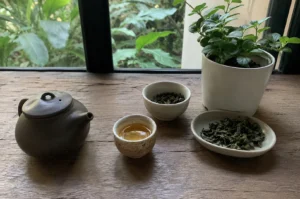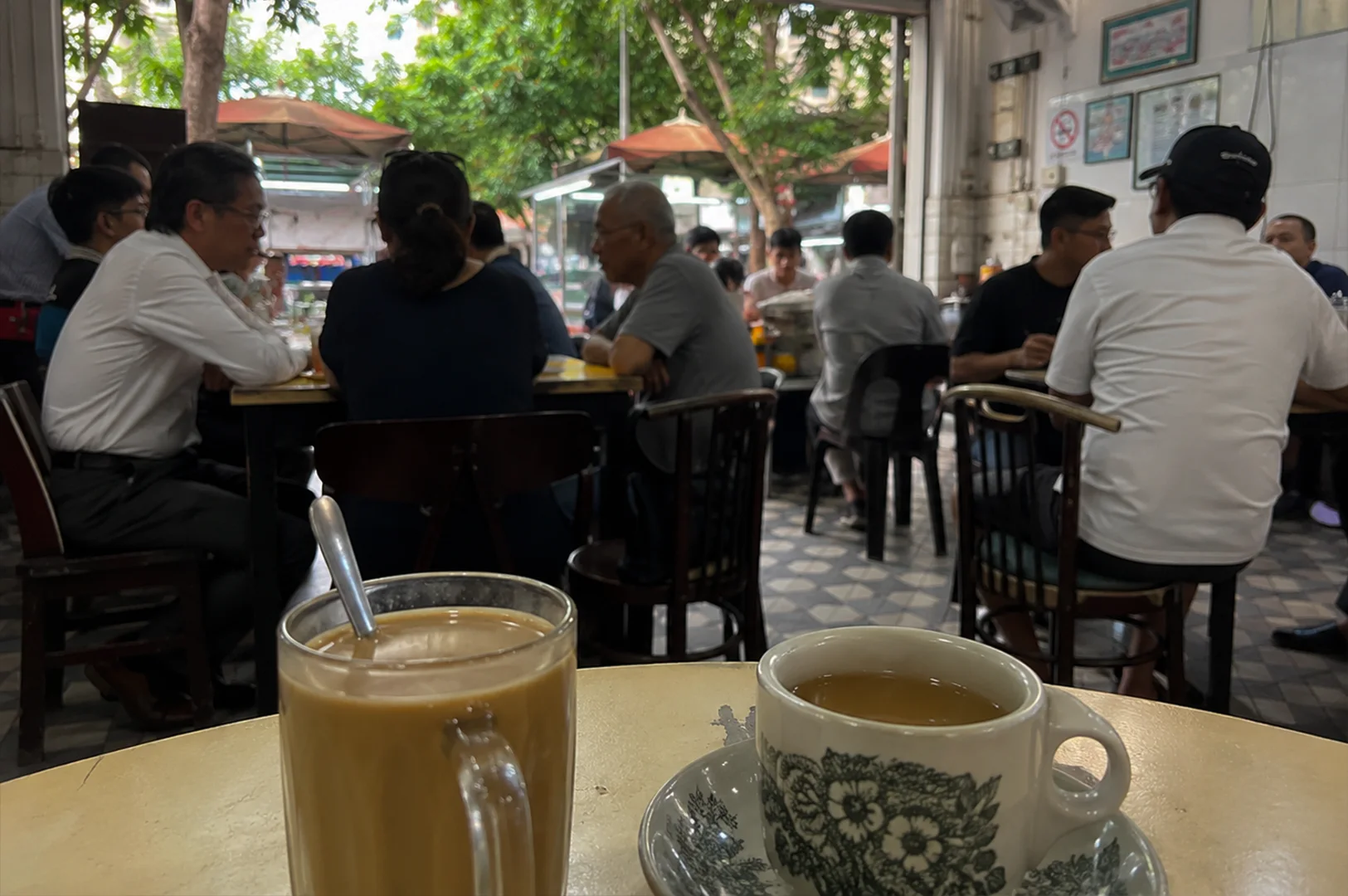
One of the things I love most about Singapore is that we never really chose between kopi and tea.
We kept both.
Walk into almost any hawker centre or coffee shop and you'll see it immediately. One person orders kopi-o. Another asks for teh-c. Someone else is drinking Chinese tea from a flask they brought from home, echoing how tea is increasingly shaping Singapore’s café culture in its own right, as Tea Manor explores.
The table somehow makes room for all of it.
For years, I assumed kopi and tea belonged to different worlds. Kopi felt practical and energetic. Tea felt slower and more reflective. One was associated with morning routines and busy coffee shops. The other seemed tied to tea houses, family gatherings, and quiet afternoons.
The older I get, the less convinced I am that the distinction is so clear.
Both drinks are deeply woven into everyday life here.
Kopi tells a story about adaptation. Coffee arrived from elsewhere, but Singapore made it its own. The roasting methods, the preparation style, even the language surrounding kopi feel uniquely local. Our friends at SG Street Eats Blog recently explored how coffee culture in Singapore stretches from traditional hawker stalls to modern specialty cafés, highlighting just how diverse the local coffee scene has become.
Tea tells a different story. It connects Singapore to centuries of Chinese, Indian, Malay, and international traditions. Every community seems to have found its own way of welcoming tea into daily life.
And yet they often exist side by side.
I find that fascinating.
Many countries have strong coffee cultures. Many have strong tea cultures. Singapore somehow embraces both without asking people to choose a side.
Perhaps that reflects something larger about the country itself.
Singapore has always been a place where traditions overlap rather than replace one another. Different influences sit next to each other, sometimes blending together and sometimes remaining distinct.
Kopi and tea do the same.
A person can start the day with kopi and end it with tea without feeling contradictory. One drink does not cancel out the other.
Both belong.
Maybe that is why debates about which is better have never interested me very much.
The more interesting question is why Singapore continues making space for both.
In a world that increasingly asks people to pick a side, there is something refreshing about a culture that simply says yes to another cup.
Whether it happens to be kopi or tea.
— Maria Tan
On tea, culture, and everyday rituals.

The Tea That Keeps Me Coming Back
I have a tea I return to more than any other. It is not rare. It is not expensive. In fact, most people would probably pass it by without a second thought. And yet, somehow, it has become a quiet companion over the years. I first drank it on a rainy afternoon. I had been…
-
Tie Guan Yin: The Iron Goddess of Chinese Oolong Tea
Tie Guan Yin, also known as Iron Goddess or Iron Goddess Oolong, is a celebrated Chinese oolong tea originating from Anxi County in Fujian Province, China. This tea from Anxi Fujian holds a special place among other teas due to its unique aroma, flavour, and rich cultural story. It is made from the tea plant…
-
Why Tea Shops Might Be the Last Quiet Places We Have
There is a growing habit in Singapore that I find both comforting and slightly unsettling. People are working everywhere now. Cafés, co-working spaces, neighborhood bakeries, even small corner shops. A laptop seems to turn any table into an office. And in many ways, this flexibility is impressive. It reflects how life has adapted to work,…
-
Why Not Every Tea Deserves Your Attention
Tea culture encourages curiosity. There are endless varieties, origins, and rituals to explore. Some teas are rare, some are aged, some are celebrated in distant mountains. The temptation is to try them all, to chase novelty in the hope that every cup will surprise you. But not every tea deserves your attention. I have learned…
-
Sipping Serenity: Where to Enjoy Chamomile Tea Singapore in the City
Singapore moves quickly. The trains run on time, the workdays stretch long, and the humidity outside rarely lets anyone slow down by choice. Yet within this busy rhythm, a quiet counter-current persists. People look for small pockets of stillness, and increasingly, they find one in a warm cup of chamomile tea. There is something fitting…
-
Why Some Teas Taste Better When Shared
I’ve always found that tea, more than most drinks, seems to gain something when shared. A cup alone can be comforting, quiet, even meditative. But a cup shared with someone else, whether a friend, a family member, or a stranger in a small tea house, somehow becomes richer, fuller, more alive. It’s not just the…
-
The Timeless Charm of Tea Culture Through English Breakfast Singapore
There is a small ritual I return to on the warmest Singapore afternoons. The city outside shimmers with heat, the air conditioning hums softly, and I reach for a familiar tin of English Breakfast tea. The kettle clicks, steam rises, and within a minute or two the kitchen fills with a warm, malty aroma that…
-
The Tea That Reminds Me of Home
I still remember the first cup of tea I drank after returning from a long trip. It was nothing remarkable, a simple black tea brewed in my kitchen but it tasted different from any cup I had drunk abroad. It wasn’t the leaves themselves. It wasn’t the water or the pot. It was the familiarity…
-
A Tea Lover’s Honest Review of Gryphon Tea Company Singapore
There is a particular hush that settles over my kitchen on a weeknight, after the dishes are done and the day finally loosens its grip. That is when I open a new box of tea from Gryphon Tea Company Singapore. Last week, the box belonged to Gryphon Singapore, and the moment I lifted the lid,…
-
Why Tea Can Teach Us About Mindful Consumption
I’ve been thinking a lot about waste lately. Not just the kind we notice-the piles of packaging, leftover food, discarded cups-but the quiet, everyday kind: the tea leaves left unused, the leaves steeped once and thrown away, the water poured down because the cup is “not perfect.” Tea has a way of making you notice…