There is a curious assumption in tea culture that I have never quite understood.
If you are new to tea, you begin with something floral.
Jasmine. Rose. Osmanthus. Lightly scented blends.
Then, supposedly, you move on.
You discover roasted oolongs. Aged teas. More complex leaves. Stronger flavours. Eventually, you become a “serious” tea drinker.
I have always found this progression rather strange.
Why should subtlety be considered an introduction rather than an achievement?
A good floral tea can be remarkably difficult to appreciate. Its character is often quiet. It does not overwhelm the palate or announce itself immediately. You have to notice what happens between the aroma and the finish, between the fragrance and the leaf beneath it.
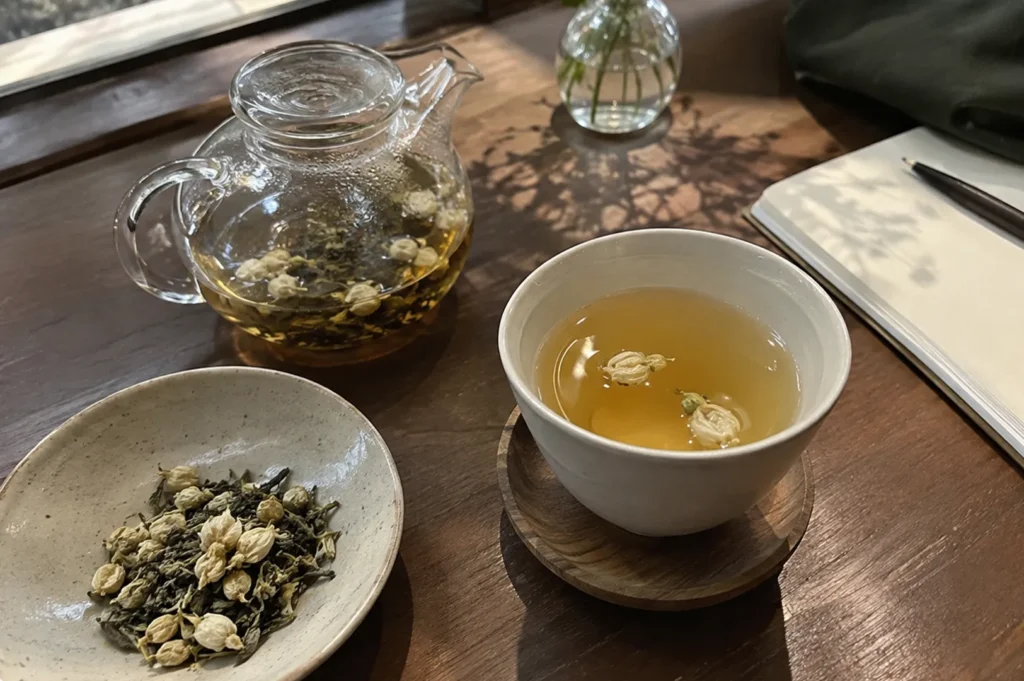
Jasmine tea is a good example.
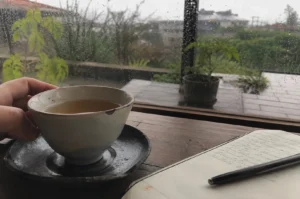
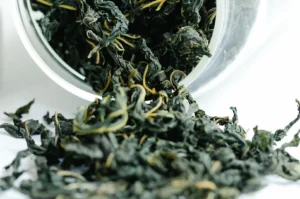
The jasmine may be the first thing you notice, but it should not be the only thing you taste. Beneath the fragrance is the tea itself, carrying its own texture and character. When the two are balanced properly, neither needs to dominate.
That balance requires restraint.
And restraint is not always easy.
I have tasted teas that were far more expensive and far more celebrated, yet I found myself returning to a simple floral tea instead. Not because it was more impressive, but because it gave me something I wanted from that particular moment.
Perhaps this is what happens as our relationship with tea changes.
In the beginning, we often look for intensity. We want flavours that are obvious and memorable. We want the tea to tell us immediately why it deserves our attention.
Eventually, some of us begin looking for something quieter.
A fragrance that does not overwhelm.
A finish that stays a little longer.
A tea that reveals itself without demanding to be noticed.
This is not to say floral teas are inherently better. They are not.
But perhaps we should stop treating them as stepping stones toward more “serious” tea.
Taste does not always become more sophisticated by becoming stronger.
Sometimes it becomes more sensitive.
And perhaps that is why I still return to floral teas.
Not because I have yet to graduate from them.
Because I no longer feel the need to.
With quiet regard,
N. P. Lim

Why We Keep Romanticising Tea Moments That Never Happened
I sometimes wonder if we are drinking tea or remembering something that never really happened. A quiet morning that feels softer in memory than it ever was in real life. A perfect cup by the window that somehow always looks better in hindsight. A tea moment that feels cinematic, even though it probably lasted only…
-
Masala Chai Tea Origins: The Cultural Evolution of India’s Spiced Tea Tradition
There is a sound that belongs to mornings across India: the hiss of milk rising in a battered pot, the clink of a spoon against metal, the low murmur of a tea seller calling out to passing crowds. Before the first sip, there is the scent. Cardamom pods, fresh ginger, and cinnamon stick curling into…
-
We Are Turning Tea Into Something It Was Never Meant to Be
There is something quietly strange happening in tea culture. The more popular the tea becomes, the more it starts to resemble everything it once stood apart from. Speed. Branding. Productivity. Performance. Tea, which once belonged to unhurried moments, is increasingly being asked to do more. To energize. To optimize focus. To replace coffee. To support…
-
Sencha Green Tea vs. Matcha Powder: Understanding the Differences in Japanese Green Tea
Two tins of tea powder sit side by side on a shelf. Both hold a fine green powder. Both promise the taste of authentic Japanese tea. To the eye, they look almost identical, and that is precisely where the confusion begins. One is matcha powder, often used in matcha lattes and desserts. The other is…
-
Discovering Gryphon Tea Company’s Earl Grey in Singapore
I recently tried the Earl Grey from Gryphon Tea Company Singapore, and I have to admit, it surprised me. Not because it was flawless-it wasn’t, but because it felt like a tea that knew exactly what it wanted to be. The aroma is the first thing that hits you. Bergamot is present but subtle, not…
-
Hojicha: The Roasted Japanese Green Tea With A Mellow Twist
There is a moment, just after the hot water meets the hojicha tea leaves, when the kitchen fills with the aroma of something toasted. Not grassy. Not sharp. Warm, like roasted nuts or the edge of a freshly baked loaf. That moment is where hojicha begins. Hojicha (sometimes spelled houjicha) is a roasted green tea…
-
A Quiet Afternoon at Yixing Xuan Teahouse
I recently spent a quiet afternoon at Yixing Xuan Teahouse, a place that feels like a pause in the city. The moment you step inside, the world seems slower. The air carries the gentle aroma of steeped leaves, and the staff move with quiet precision. I chose an oolong, simple yet familiar. Watching the leaves…
-
The Controversial Smoky Tea That Divides Enthusiasts: Lapsang Souchong Black Tea
There is a tea that empties rooms and fills them in equal measure. Open a box of loose leaf lapsang souchong black tea, and someone nearby will lean in with delight while another quietly steps away. Few teas provoke such immediate, honest reactions. That divide is part of its story. This smoked lapsang souchong smells…
-
The Tea That Keeps Me Coming Back
I have a tea I return to more than any other. It is not rare. It is not expensive. In fact, most people would probably pass it by without a second thought. And yet, somehow, it has become a quiet companion over the years. I first drank it on a rainy afternoon. I had been…
-
Tie Guan Yin: The Iron Goddess of Chinese Oolong Tea
Tie Guan Yin, also known as Iron Goddess or Iron Goddess Oolong, is a celebrated Chinese oolong tea originating from Anxi County in Fujian Province, China. This tea from Anxi Fujian holds a special place among other teas due to its unique aroma, flavour, and rich cultural story. It is made from the tea plant…