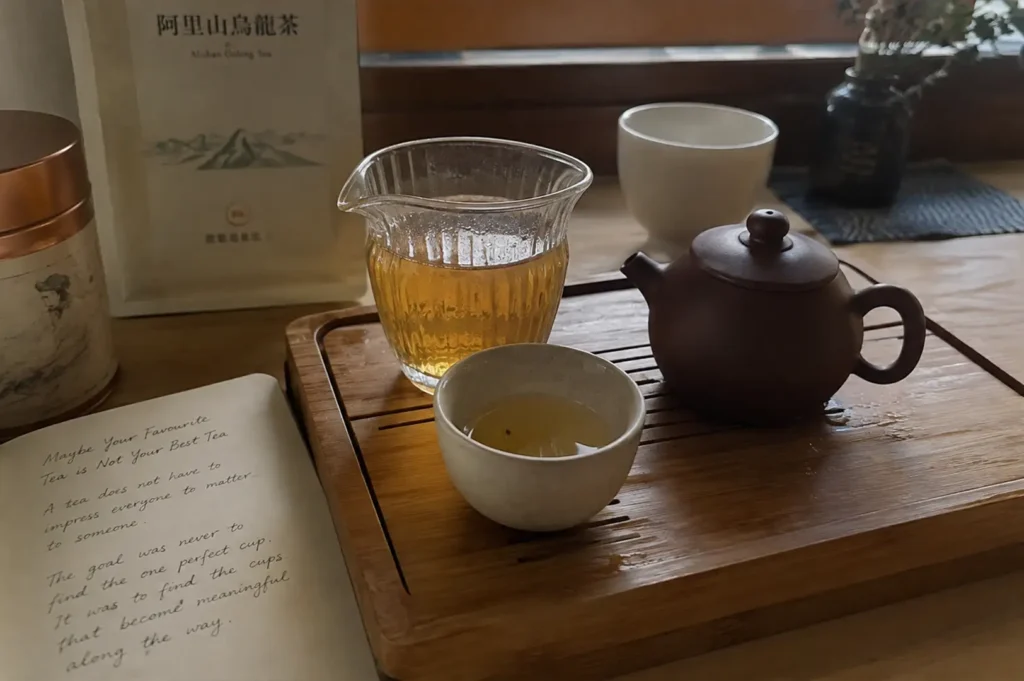
I have a tea sitting in my cupboard that I would never call my “best” tea.
It is not the rarest. It is not the most expensive. It does not come with an impressive story about ancient tea trees, remote mountains, or a limited harvest.
And yet, I drink it more often than almost anything else.
This has always fascinated me.
We spend a lot of time talking about the best teas. The finest oolong. The most delicate white tea. The matcha with the brightest colour and smoothest texture.
There is nothing wrong with appreciating quality. Tea deserves the attention it receives. Understanding where a tea comes from, how it is made, and why it tastes the way it does can make the experience much richer.
But I sometimes wonder if we confuse “best” with “most impressive.”
Because those are not always the same thing.
A tea can be extraordinary and still not become part of your daily life.
I remember trying a tea that many people considered exceptional. The aroma was beautiful. The flavours were complex. Every sip seemed to reveal something new. I understood why people loved it.
But when I finished the cup, I did not feel the urge to make another.
Meanwhile, there were simpler teas I kept returning to without thinking. The tea I reached for on busy mornings. The tea I brewed when I wanted comfort. The tea that somehow became familiar before I even realised it.
Perhaps that is the difference between a tea we admire and a tea we love.
Admiration comes from recognising something special.
Love comes from returning to it.
I think many tea lovers experience this quietly. We collect interesting teas. We search for discoveries. We get excited about recommendations from others.
But eventually, there are only a few teas that become part of our rhythm.
They become the teas we trust.
The ones we do not need to think about.
The ones that are waiting when the day feels too long.
Maybe this is why I have become less interested in finding the “best” tea and more interested in finding the tea that fits a moment.
The best tea for a quiet morning may not be the best tea for a conversation with friends. The best tea for celebration may not be the tea you want after a difficult day.
Tea is personal in that way. A tea does not have to impress everyone to matter to someone. And perhaps that is the beauty of tea appreciation.
The goal was never to find the one perfect cup.
It was to find the cups that become meaningful along the way.
So I wonder, what is the tea you keep returning to, even if it is not the one you call your best?
— Maria Tan
On tea, culture, and everyday rituals.

A Tea Lover’s Guide to the Best Japanese Restaurant Singapore Dining Experiences
Searching for the best Japanese restaurant Singapore offers usually leads people toward sushi counters, omakase menus, or beautifully plated sashimi. Those elements certainly define much of the appeal of Japanese cuisine, but anyone who has spent time dining in Japan knows that the experience rarely ends with the food alone. Tea quietly accompanies the meal….

Why Tea Conversations Always Last Longer Than Expected
There is a small pattern I have started to notice about tea. Whenever tea is involved, conversations tend to last longer than planned. Someone says they will only stay for a short while. A kettle is placed on the stove. Tea is poured into a few cups, and suddenly the conversation begins to stretch in…
-
White Tea: The Most Delicate Expression of Chinese Tea
Introduction Among the many tea types that have emerged from centuries of tea cultivation, white tea often stands apart for its quiet character. It is light in colour, gentle in aroma, and remarkably simple in its making. Yet behind this softness lies a long tradition of craftsmanship that has shaped some of the most refined…
-
The Quiet Discipline of Brewing Tea
There is a quiet discipline that lives inside the act of brewing tea. It is not something that announces itself loudly. There are no strict rules written on the wall, no visible signs that something significant is taking place. From the outside, the process appears simple enough. Water is heated. Leaves are placed into a…
-
Understanding the Six Types of Chinese Tea and What Makes Each Unique
Introduction Across centuries of Chinese culture, tea has held a place of quiet importance. It appears in homes, markets, and tea houses across China, where the simple act of sharing a cup reflects patience, hospitality, and tradition. For many people, Chinese tea is not only a beverage. It is a moment of reflection and a…
-
Stepping Into a Tea Shop Singapore: A World of Leaves, Craft, and Calm
Introduction A good tea shop Singapore offers is not simply a place to buy tea. It is a place where flavour, craft, and tradition meet. In a city known for speed and convenience, a proper tea house offers something different. It invites people to slow down, pay attention, and actually taste what is in their…
-
When Tea Becomes Too Beautiful to Drink
I recently saw a photograph of a tea session online that looked almost too perfect. The teapot sat neatly on a polished tray. The cups were aligned in a way that suggested someone had carefully adjusted them, perhaps more than once. A small branch of flowers leaned gently toward the tea set as if it…

How Tea in Singapore Traveled From Colonial Tables to Modern Teahouses
Tea in Singapore moves quietly through the day, carrying within its steam the gentle convergence of traditions that have found their way to this island over generations. In the soft morning light of hawker centers, the rhythmic pour of teh tarik creates small moments of pause, while afternoon finds its way into tranquil tea rooms…

Are We Drinking Tea or Just Collecting It?
There was a time when buying tea meant something simple. You chose a tea you liked, brought it home, and brewed it. The leaves were meant for hot water, not long-term storage. Yet something has quietly changed. Today it is not unusual to meet tea drinkers with shelves filled with sealed cakes, tins, and packets…

The Soul of Tea: Unveiling the Beauty of Traditional Tea Ceremonies
Tea is more than just a drink, isn’t it? It is a quiet moment in the middle of a busy day, a small ritual that grounds us. We are not just drinking tea; we are experiencing something far more profound, a glimpse into the centuries-old traditions of cultures that revere this simple beverage. Whether in…