I used to believe that discovering better tea meant gradually leaving ordinary preferences behind.
The more I learned, the more refined my tastes were supposed to become. I would move towards rarer leaves, more complicated flavours, and teas that demanded greater attention.
But taste does not always develop in a straight line.
Some teas remain with us. Others gradually lose their appeal.
And I have come to think there is nothing unfortunate about that.
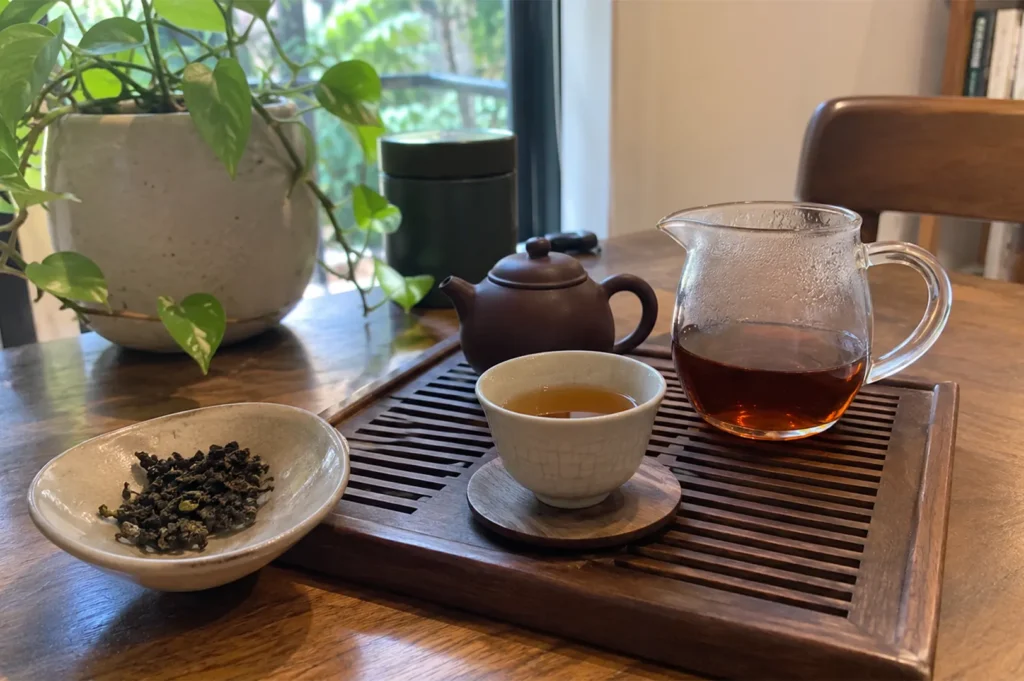
Dong Ding oolong is the kind of tea I find myself returning to. Particularly the traditionally roasted styles from Taiwan, where the warmth of the roast sits alongside a gentle sweetness.
It offers complexity without demanding that I analyse every infusion.
There is comfort in that familiarity.
I feel something similar about ripe Pu-erh, or shou Pu-erh. Its earthy, mellow character can seem unremarkable to those searching for bright aromas and dramatic flavours.
But I increasingly appreciate teas that do not need to announce themselves.
Not every cup needs to surprise me.
Then there are teas I have gradually outgrown.
Japanese sencha once represented much of what I admired about tea. Its grassy freshness, savoury character, and sometimes sharp finish seemed to reward careful preparation.
I still recognise those qualities.
Yet I no longer reach for that particular flavour as often. What once felt exciting can now feel less suited to the way I prefer to drink tea.
That does not make sencha inferior.
It simply means my preferences have changed.
I think tea enthusiasts sometimes struggle with this distinction. We become attached to the idea that our taste should continuously advance towards something more sophisticated.
But perhaps developing a palate is not about climbing a hierarchy.
Perhaps it is about becoming more honest with ourselves.
A tea we once loved can remain excellent even when we no longer desire it. And a familiar, inexpensive tea can continue to offer pleasure long after we have encountered supposedly finer alternatives.
There is no need to defend either choice.
I no longer want my tea collection to represent how much I have learned.
I want it to reflect what I genuinely enjoy drinking.
The difference, I think, is worth keeping.
With quiet regard,
N. P. Lim

Scent, Memory, and a Kettle: How Tea Anchors My Days
There are certain smells that bring us somewhere else before we even realise it. The scent of rain on warm pavement. A familiar perfume. The food someone used to make when we were younger. For me, tea belongs in that category. Sometimes, before I even take a sip, the aroma is enough to bring back…
-
The Chinese Yixing Teapot: More Than a Teapot, a Living Tea Tradition
The first time I held a Chinese Yixing teapot, I wasn’t ready for how warm it would feel. Small, reddish-brown, sitting in my palm like a river stone that had been kept somewhere warm. I’d just rinsed it with hot water, the way you’re supposed to before the first brew, and the clay drank up…
-
Your “Tea Sommelier” Might Be Selling You a Vibe, Not a Better Cup
There is a particular moment that has become increasingly familiar in modern tea culture. A tea is presented. Before the first sip, we are introduced to its story. The region. The altitude. The history. The carefully chosen words that describe its character. Perhaps there are notes of wildflowers, distant forests, roasted grains, or forgotten memories….
-
Does Tea Contain Caffeine? Understanding What’s Really in Your Tea
There’s a quiet moment many of us know well. The kettle clicks off. Steam curls up. You wrap your hands around a warm cup and feel your shoulders drop, just a little. Tea has always carried this sense of calm, of slowing down. So it can feel almost contradictory to ask: does tea contain caffeine?…
-
“Detox Tea” Is Mostly Marketing: Here’s What Tea Actually Does
I have always found the phrase “detox tea” a little strange. Not because I dislike tea. Quite the opposite. Tea has been part of my daily life for years. I love the quiet ritual of choosing leaves, waiting for the water, and taking a moment to slow down. But somewhere along the way, tea became…
-
The Tea House That Time Did Not Forget: Tea Chapter Trading Pte Ltd
I almost walked past it. Located at Nine Neil Road, Tea Chapter Trading Pte Ltd sits quietly, a three-storey shophouse just across from Maxwell MRT in Singapore, its restored facade catching afternoon light. Around it, Chinatown moves at its usual pace. Inside, something slower has been happening since October 1989. I stepped in on a…
-
Expensive Tea Doesn’t Guarantee a Better Cup, Here’s Why
There is a belief in tea that we rarely question. If something costs more, it must be better. It is an understandable assumption. A rare tea from a respected region, carefully harvested and beautifully packaged, naturally creates expectations. We associate price with effort, craftsmanship, and quality. And often, that connection is justified. But not always….
-
SUN with MOON Singapore at Wheelock Place: A Unique Tea Dining Cafe Experience on Orchard Road
The lunch crowd had gone. Dinner hadn’t arrived yet. I came in during that strange, in-between hour, a little after three on a weekday, when the escalators at Wheelock Place hum quietly and Orchard Road feels almost gentle. Most people were still at their desks. I wasn’t. I wanted tea, and I wanted to sit…
-
Cold Brew Tea Is Underrated (And Hot Purists Are Missing Out)
I used to think tea had to be hot. There was something about the ritual of it. Boiling water, warming the pot, watching the leaves open. A proper cup of tea seemed to require steam. Then I tried cold brew tea, and I had to admit something slightly uncomfortable. I liked it. More than I…
-
All Things Delicious Review: The Quiet Pleasure of Tea and Cake.
There’s a particular kind of afternoon that asks for tea, and All Things Delicious answers it with a quiet, comforting tea-and-cake experience on Arab Street: handmade sweet treats, warm approachable teas, and a room that makes simple pleasures feel like enough. Not coffee, with its urgency. Tea. The slow kind, poured while the conversation drifts…