I used to believe that discovering better tea meant gradually leaving ordinary preferences behind.
The more I learned, the more refined my tastes were supposed to become. I would move towards rarer leaves, more complicated flavours, and teas that demanded greater attention.
But taste does not always develop in a straight line.
Some teas remain with us. Others gradually lose their appeal.
And I have come to think there is nothing unfortunate about that.
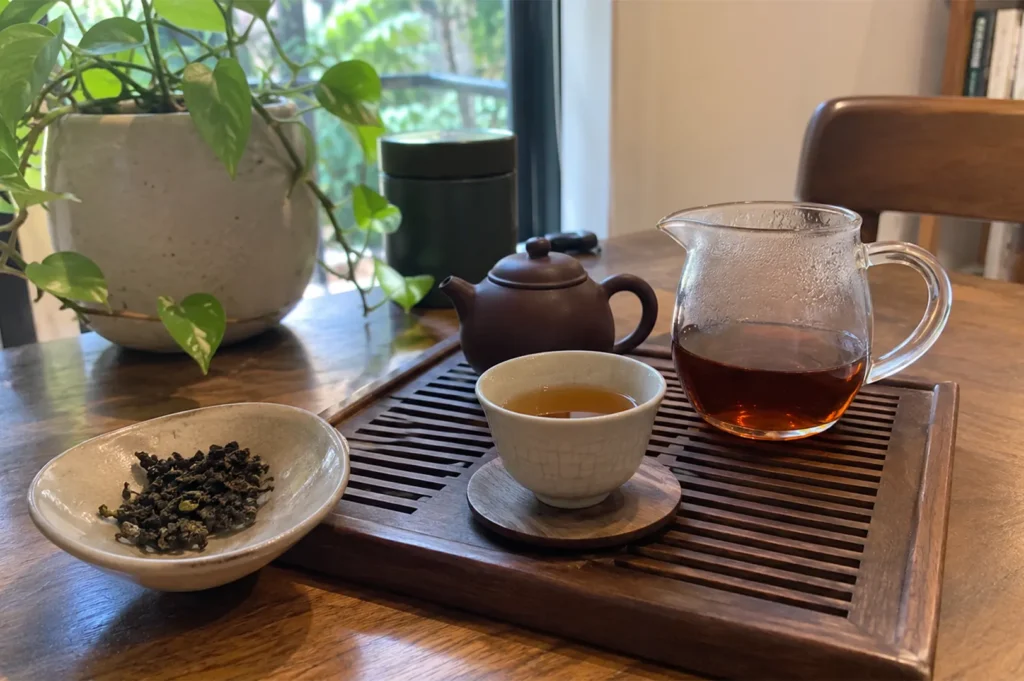
Dong Ding oolong is the kind of tea I find myself returning to. Particularly the traditionally roasted styles from Taiwan, where the warmth of the roast sits alongside a gentle sweetness.
It offers complexity without demanding that I analyse every infusion.
There is comfort in that familiarity.
I feel something similar about ripe Pu-erh, or shou Pu-erh. Its earthy, mellow character can seem unremarkable to those searching for bright aromas and dramatic flavours.
But I increasingly appreciate teas that do not need to announce themselves.
Not every cup needs to surprise me.
Then there are teas I have gradually outgrown.
Japanese sencha once represented much of what I admired about tea. Its grassy freshness, savoury character, and sometimes sharp finish seemed to reward careful preparation.
I still recognise those qualities.
Yet I no longer reach for that particular flavour as often. What once felt exciting can now feel less suited to the way I prefer to drink tea.
That does not make sencha inferior.
It simply means my preferences have changed.
I think tea enthusiasts sometimes struggle with this distinction. We become attached to the idea that our taste should continuously advance towards something more sophisticated.
But perhaps developing a palate is not about climbing a hierarchy.
Perhaps it is about becoming more honest with ourselves.
A tea we once loved can remain excellent even when we no longer desire it. And a familiar, inexpensive tea can continue to offer pleasure long after we have encountered supposedly finer alternatives.
There is no need to defend either choice.
I no longer want my tea collection to represent how much I have learned.
I want it to reflect what I genuinely enjoy drinking.
The difference, I think, is worth keeping.
With quiet regard,
N. P. Lim

Stop Buying Tea for the Aesthetic: How Packaging Hijacks Taste
There is something fascinating about the way we buy tea today. Before we taste the leaves, we have already formed an opinion. The box is elegant. The label is beautifully designed. The colours suggest calm, luxury, or tradition. The story feels carefully written. And before the first sip, we have already decided that the tea…
-
A Tea Table in the Clouds: The Westin Singapore High Tea Review
It was one of those afternoons when the city felt too loud and too fast, and I wanted to sit somewhere quiet without really explaining why. So I went up. All the way up, to Level 32 of The Westin Singapore, where the Lobby Lounge sits above the noise like it knows something the rest…
-
“Caffeine-Free Tea” Confuses Everyone—Let’s Fix the Language
I have noticed that tea conversations can become surprisingly confusing. Not because tea itself is complicated, but because we sometimes use the same words to mean completely different things. One phrase that always catches my attention is “caffeine-free tea.” It sounds simple enough. A tea without caffeine. But is that really what we mean? Because…
-
The Pull, Pour, and Ritual Behind Singapore’s Favourite Milk Tea: Teh Tarik
It starts with a sound. A long ribbon of tea, arcing from one metal mug held high to another held low. The stream catches the light. Then the froth rises, pale and soft, and the whole thing gets poured back and lifted again. Nobody at the stall looks up. This happens a hundred times a…
-
Stop Chasing Tasting Notes: Tea Isn’t Wine and That’s a Relief
I have a small confession to make. Sometimes I have absolutely no idea what I am supposed to be tasting. A tea description might promise orchid, honey, toasted nuts, stone fruit, and something wonderfully mysterious called a “long mineral finish.” I take a sip. I taste tea. And then I start wondering if everyone else…
-
Chinese Tea Sets: Beautiful on the Table, But How Do They Brew?
There is a small arrangement on the table this evening, and I have not touched it yet. A pale bowl with a lid resting slightly askew. A round pitcher beside it, waiting to be filled. Cups no larger than a thumb and two fingers, lined up like a quiet sentence. The surfaces catch the last…
-
Floral Teas Are Not “For Beginners”—They’re For People With Taste
There is a curious assumption in tea culture that I have never quite understood. If you are new to tea, you begin with something floral. Jasmine. Rose. Osmanthus. Lightly scented blends. Then, supposedly, you move on. You discover roasted oolongs. Aged teas. More complex leaves. Stronger flavours. Eventually, you become a “serious” tea drinker. I…
-
How to Make Cold Brew Tea: The Slow Method for a Smoother Cup
There is a jar on the top shelf of my refrigerator that I did not need this morning. I filled it last night, before the kitchen went dark. Loose tea leaves, cool water, a lid resting loosely on top. Then I closed the door and left it alone, the way you leave bread to rise…
-
Milk Tea Isn’t “Ruining” Tea—But Some Milk Tea Is Ruining Milk Tea
I have noticed that few things can start an argument among tea drinkers quite as quickly as milk. Mention adding milk to a good tea and suddenly everyone has an opinion. Some insist that milk covers the flavour of the leaves. Others will tell you that certain teas were practically made for it. I have…
-
There Are Always Good Things to Eat at The Marmalade Pantry
The afternoon rain had just eased when I climbed up to Level 4 of ION Orchard, home to the Marmalade Pantry Ion. Outside, Orchard Road was doing its usual thing: too many people, too much noise, everyone somewhere to be in the bustle of the city. Inside, at a corner table, someone was pouring tea…