There is a curious assumption in tea culture that I have never quite understood.
If you are new to tea, you begin with something floral.
Jasmine. Rose. Osmanthus. Lightly scented blends.
Then, supposedly, you move on.
You discover roasted oolongs. Aged teas. More complex leaves. Stronger flavours. Eventually, you become a “serious” tea drinker.
I have always found this progression rather strange.
Why should subtlety be considered an introduction rather than an achievement?
A good floral tea can be remarkably difficult to appreciate. Its character is often quiet. It does not overwhelm the palate or announce itself immediately. You have to notice what happens between the aroma and the finish, between the fragrance and the leaf beneath it.
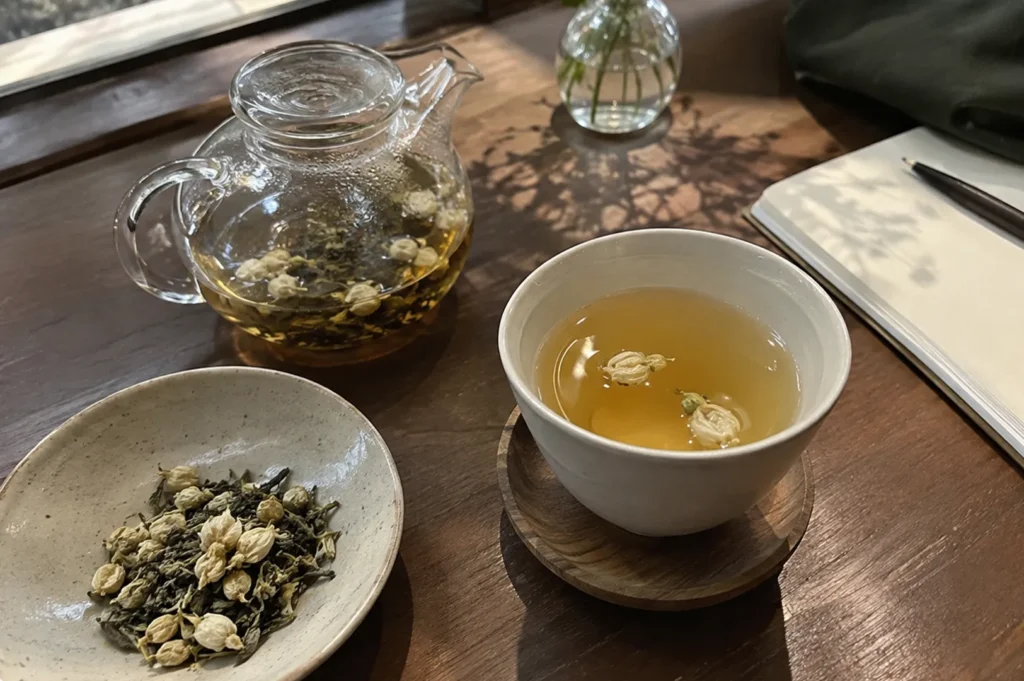
Jasmine tea is a good example.
The jasmine may be the first thing you notice, but it should not be the only thing you taste. Beneath the fragrance is the tea itself, carrying its own texture and character. When the two are balanced properly, neither needs to dominate.
That balance requires restraint.
And restraint is not always easy.
I have tasted teas that were far more expensive and far more celebrated, yet I found myself returning to a simple floral tea instead. Not because it was more impressive, but because it gave me something I wanted from that particular moment.
Perhaps this is what happens as our relationship with tea changes.
In the beginning, we often look for intensity. We want flavours that are obvious and memorable. We want the tea to tell us immediately why it deserves our attention.
Eventually, some of us begin looking for something quieter.
A fragrance that does not overwhelm.
A finish that stays a little longer.
A tea that reveals itself without demanding to be noticed.
This is not to say floral teas are inherently better. They are not.
But perhaps we should stop treating them as stepping stones toward more “serious” tea.
Taste does not always become more sophisticated by becoming stronger.
Sometimes it becomes more sensitive.
And perhaps that is why I still return to floral teas.
Not because I have yet to graduate from them.
Because I no longer feel the need to.
With quiet regard,
N. P. Lim

Not All Comfort Is Sweet: The Bitterness I Now Appreciate
I used to think comfort was supposed to be easy. A familiar drink. A familiar taste. Something that immediately made me feel better. For a long time, I gravitated towards teas that were gentle. Soft flavours. Natural sweetness. Anything that felt welcoming from the first sip. Then I started appreciating bitter teas. Not because I…
-
Understanding the Herb Behind the Refreshing Cup: Peppermint Tea
There is a moment, just after the hot water meets the fresh peppermint leaves, when the whole room seems to change. A sharp, green coolness lifts from the cup and settles somewhere behind your eyes. Drinking peppermint tea does this quietly, without fuss. It asks for nothing and offers a great deal. Most of us…
-
Why Most People Hate Oolong: Overcomplicated Advice Ruined It
I have always found it interesting that oolong tea is one of the most misunderstood teas. People often describe it as complicated. Too many varieties. Too many brewing methods. Too many rules. The leaves should be prepared this way. The water should be at this temperature. The teapot should be a certain material. The first…
-
Kempinski Singapore High Tea Review: When Afternoon Tea Feels Like an Occasion
The rain had come and gone by the time I arrived, leaving the street outside slick and quiet. I stepped in without knowing quite what I wanted from the afternoon. Only that I wanted it to be slow. The Lobby Lounge at The Capitol Kempinski Hotel Singapore does not rush you. It waits. And there…
-
Scent, Memory, and a Kettle: How Tea Anchors My Days
There are certain smells that bring us somewhere else before we even realise it. The scent of rain on warm pavement. A familiar perfume. The food someone used to make when we were younger. For me, tea belongs in that category. Sometimes, before I even take a sip, the aroma is enough to bring back…
-
The Chinese Yixing Teapot: More Than a Teapot, a Living Tea Tradition
The first time I held a Chinese Yixing teapot, I wasn’t ready for how warm it would feel. Small, reddish-brown, sitting in my palm like a river stone that had been kept somewhere warm. I’d just rinsed it with hot water, the way you’re supposed to before the first brew, and the clay drank up…
-
Your “Tea Sommelier” Might Be Selling You a Vibe, Not a Better Cup
There is a particular moment that has become increasingly familiar in modern tea culture. A tea is presented. Before the first sip, we are introduced to its story. The region. The altitude. The history. The carefully chosen words that describe its character. Perhaps there are notes of wildflowers, distant forests, roasted grains, or forgotten memories….
-
Does Tea Contain Caffeine? Understanding What’s Really in Your Tea
There’s a quiet moment many of us know well. The kettle clicks off. Steam curls up. You wrap your hands around a warm cup and feel your shoulders drop, just a little. Tea has always carried this sense of calm, of slowing down. So it can feel almost contradictory to ask: does tea contain caffeine?…
-
“Detox Tea” Is Mostly Marketing: Here’s What Tea Actually Does
I have always found the phrase “detox tea” a little strange. Not because I dislike tea. Quite the opposite. Tea has been part of my daily life for years. I love the quiet ritual of choosing leaves, waiting for the water, and taking a moment to slow down. But somewhere along the way, tea became…
-
The Tea House That Time Did Not Forget: Tea Chapter Trading Pte Ltd
I almost walked past it. Located at Nine Neil Road, Tea Chapter Trading Pte Ltd sits quietly, a three-storey shophouse just across from Maxwell MRT in Singapore, its restored facade catching afternoon light. Around it, Chinatown moves at its usual pace. Inside, something slower has been happening since October 1989. I stepped in on a…